
A candidate can accept being rejected by a person.
They may disagree with the decision. They may feel disappointed, frustrated, even hurt. Still, there is a recognizable social shape to the moment. Someone listened. Someone formed a view. Someone can, at least in principle, explain what happened.
AI changes that shape.
When a candidate hears that AI is involved in hiring, the first fear is rarely technical. It is not about model architecture or prompt design. It is about authority. Who is listening? Who is judging? Who has the final word?
That is why AI in hiring has a trust problem before it has a product problem.

The room matters
One of our customers once explained it better than any product description could. When explaining AI Interview Analyzer to candidates, she did not describe it as a system that makes decisions for the hiring team. She described it as a third party observing the interview.
That one sentence matters.
The same analysis can feel completely different depending on where the AI stands in the room. If the AI sits across the table, it feels like another interviewer, perhaps the real interviewer. If it stands in the corner taking notes, the human conversation remains intact.
The technology may be similar. The role is not.
This is the difference many AI hiring products blur. They discuss accuracy, speed, workflow coverage, automation, and candidate ranking. All of that matters when it supports human judgment. But before a candidate asks whether the tool is accurate, they ask a more basic question: am I being evaluated by people, or by a machine?
The anxiety is already visible
This is not hypothetical nervousness. Pew Research Center reported in 2025 that 52% of workers felt worried about how AI may be used in the workplace, while only 6% believed workplace AI would create more job opportunities for them in the long run.
In hiring, the concern becomes even sharper. Gartner reported in 2025 that only 26% of job applicants trusted AI to evaluate them fairly. A quarter of candidates said they trusted employers less if AI was used to evaluate their information.
Those numbers are not just about AI. They are about employers.
Hiring is one of the few business processes where a company asks a person to be vulnerable, to explain their work, defend their choices, show where they are still developing, and accept judgment. When AI enters that process, it does not enter a neutral workflow. It enters a room already full of status, anxiety, hope, and asymmetry.
Public reactions to AI show the same emotional charge. AP reported in 2026 that graduates booed AI-themed commencement speeches, including a speech by former Google CEO Eric Schmidt at the University of Arizona. The reaction was not a careful policy objection. It was a human response to the feeling that work is being redesigned somewhere else, by someone else, for someone else's benefit.
Recruitment sits inside that feeling.
The problem is not evaluation. The problem is who owns the decision.
This distinction matters for serious products, because AI can evaluate interview content in a useful way.
It can notice that a candidate gave a strong example. It can connect an answer to a documented role criterion. It can remind the recruiter of what was actually said, instead of what everyone vaguely remembers after five interviews. It can suggest that an answer deserves a follow-up question. It can compare candidates side by side and expose trade-offs that a quick debrief might miss.
None of that requires AI to own the decision.
The trust problem begins when the product, or the way the product is introduced, relocates authority away from people. The candidate no longer feels that AI is helping the humans understand the interview. They feel that AI has become the place where the decision happens.
That is a very different psychological contract.
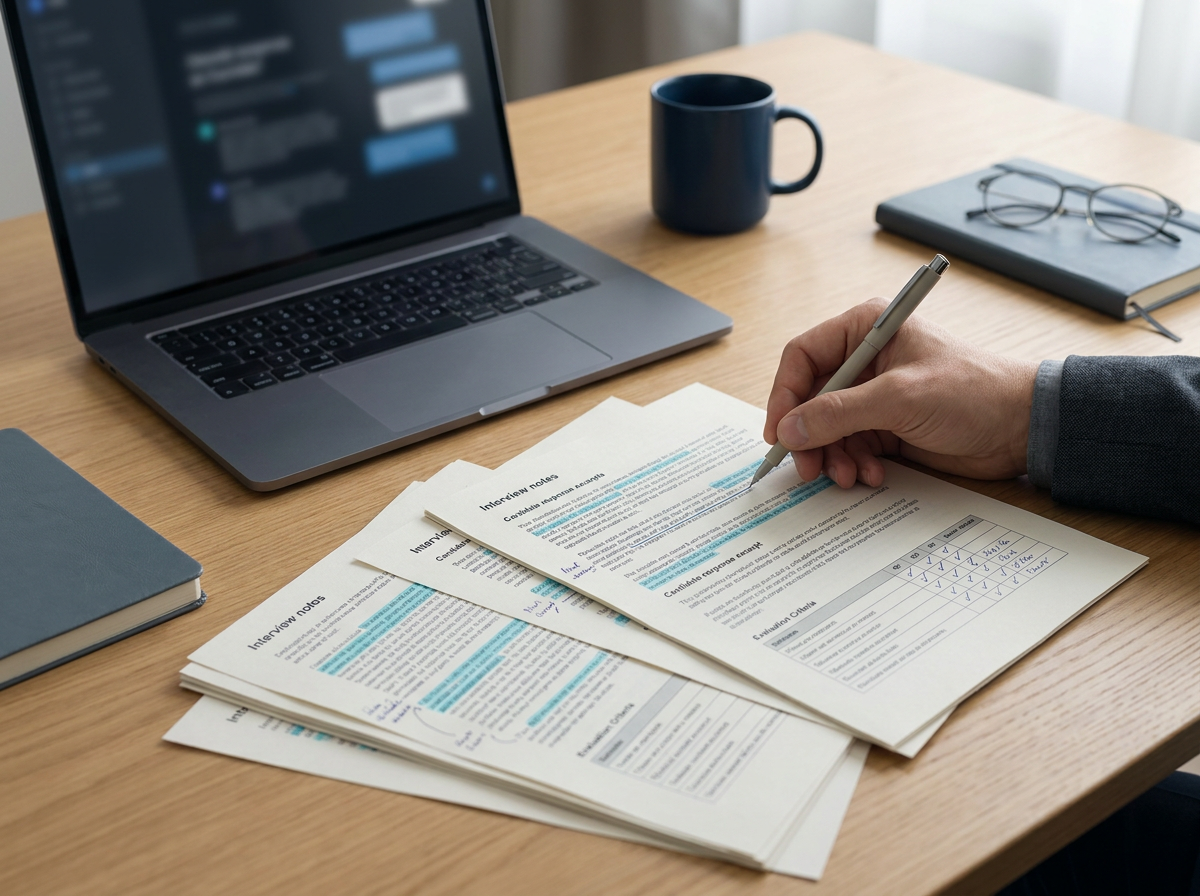
A recruiter can disagree with an observation. A hiring manager can weigh evidence differently. A candidate can understand that a human team made a judgment. A black-box system leaves no room for that. It feels final, but not human.
A product can be complete and still be mistrusted
The obvious vendor response is to show more capability.
More features. More automation. More dashboards. More summaries. More integrations.
Capability is necessary. Hiring is not one task, and a thin AI layer over a transcript will not solve much. A serious hiring product has to follow the interview through its real life: preparation, live conversation, evidence, evaluation, comparison, debrief, candidate feedback.
Still, completeness is not the same as trust.
The real question is whether the product makes the process more accountable. Does it show where the evidence came from? Does it let the recruiter review and correct the interpretation? Does it make clear that a score is a signal, not a verdict? Does it help the candidate receive something useful without pretending that the AI is the person who rejected them?
This is where product completeness and trust have to meet. The goal is not fewer humans in the process. The goal is fewer weak records, fewer memory-based debriefs, fewer unexplained decisions, fewer candidates leaving with silence.
The observer model
The better model is simple: AI as observer, not authority.
An observer can notice. An observer can organize. An observer can compare. An observer can ask, "did we miss something?" An observer can help the candidate understand strengths and next steps after the process.
An observer does not hire. An observer does not reject. An observer does not turn a person's voice, accent, personality, or supposed cultural fit into hidden evidence.
This is more than tone. It affects the product itself. It affects what the system is allowed to infer, how outputs are written, how evidence is displayed, and how the hiring team reviews the result. It also affects candidate communication. A candidate should not be told, implicitly or explicitly, that AI is the interviewer behind the interviewer.
They should understand the arrangement: the people are conducting the interview; AI is helping preserve and structure what happens; the people remain responsible for the decision.
That sentence is less spectacular than "AI interviewer." It is also more credible.
What employers should ask
The most useful questions for employers are not theatrical. They are plain.
Where does AI stand in this process?
Can a candidate understand its role?
Can a recruiter challenge the output?
Can a hiring manager see the evidence behind the evaluation?
Does the product help the team make a better decision, with people still responsible for it, or does it quietly move the decision into the system?
These questions are often treated as legal or compliance details. They are really adoption questions. A hiring tool that candidates distrust will damage the process it was meant to improve. A tool that recruiters experience as replacement will meet resistance even when it is technically useful.
AI in hiring will not be trusted because vendors promise it is fair. It will be trusted when the process shows where the AI stands, what it observed, what it did not infer, and who owns the final decision.
The question is not only whether AI belongs in recruitment.
It already does.
The question is where it stands in the room.
References
- Pew Research Center: Workers' views of AI use in the workplace. Used for the wider workplace trust context: workers are more worried than hopeful about AI at work.
- Gartner: Just 26% of job applicants trust AI will fairly evaluate them. Used for the hiring-specific trust statistic and employer trust risk.
- AP News: Graduates are booing pep talks on AI at college commencements. Used as a cultural proof point that AI anxiety is public, emotional, and tied to work.