
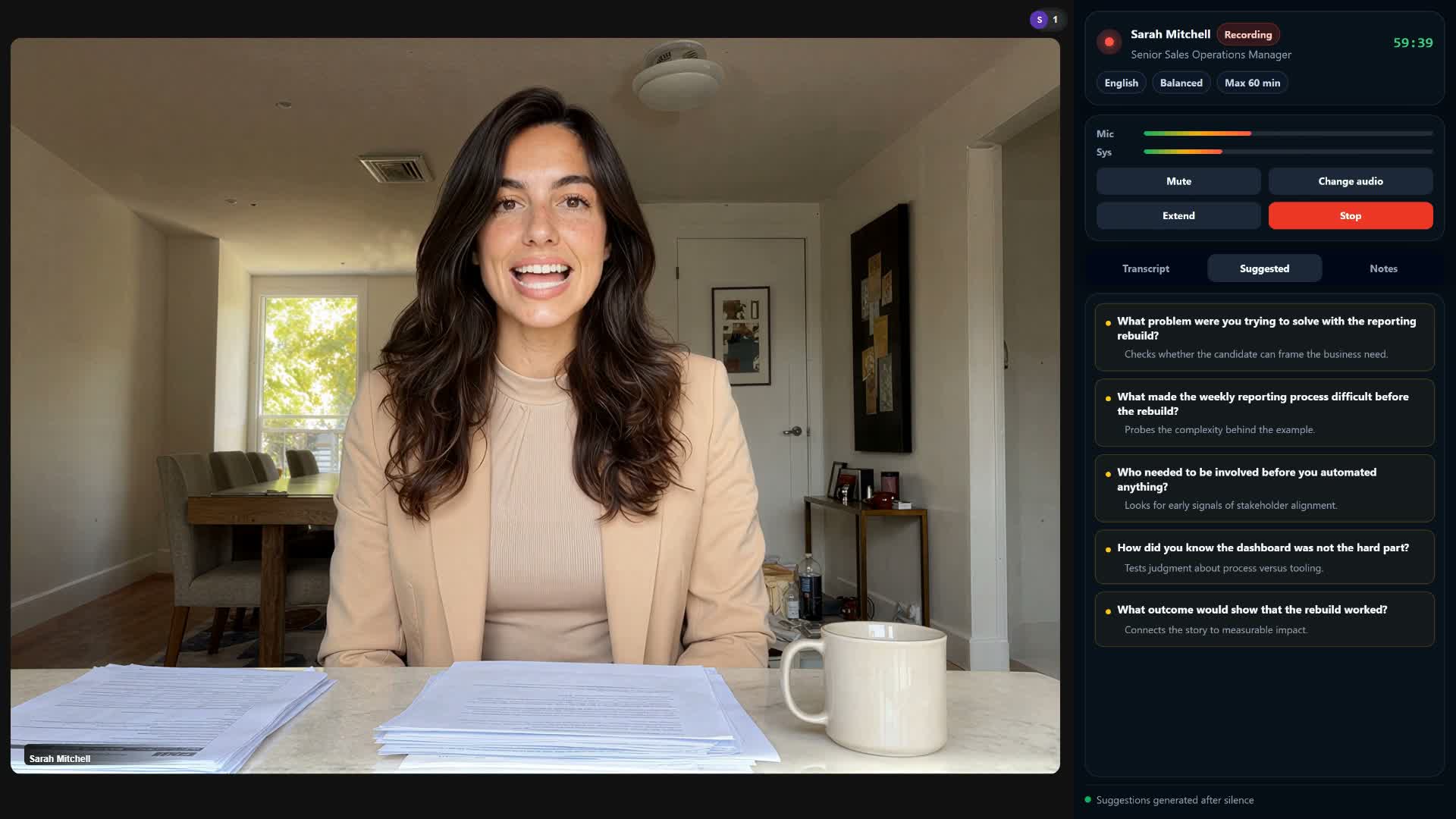
Recording Now Fits the Interview
AI Interview Analyzer already supported interview recording in the desktop app and the web app. Hiring teams could record a conversation, generate a transcript, score answers against role criteria, compare candidates, and create feedback.
That workflow worked. The friction was the live interview moment itself.
Most interviews happen in Teams, Zoom, or Google Meet. The interviewer is listening, asking follow-up questions, taking notes, and trying to keep the conversation natural for the candidate. When the call is in one window and AI Interview Analyzer is in another, the product can do the job, but the experience is heavier than it needs to be.
The browser extension removes that split. It brings recording and live assistance into the same browser context as the interview, so the useful record starts where the conversation actually happens.
What the Extension Does
The extension lets hiring teams record browser-based interviews directly from the meeting context.
The interviewer can stay in the call instead of switching between windows or rebuilding the conversation later. The extension captures the interview and connects it back to the same workspace where the team prepares criteria, reviews answers, compares candidates, and sends feedback.
That matters because the details that shape a hiring decision are created during the conversation. The more naturally those details are captured, the more likely the team is to use them instead of relying on scattered notes and memory.
The extension is designed for the normal tools hiring teams already use:
- Microsoft Teams
- Zoom
- Google Meet
It is not a separate hiring room, and it does not replace the desktop or web recording flows. It is a simpler capture layer for the interviews teams already run in the browser.
Why This Makes the Product Feel Complete
AI Interview Analyzer now covers the full interview loop in a cleaner way.
Before the interview, the team prepares role criteria and questions. During the interview, the conversation can be recorded from the browser with live transcript context, notes, and AI-supported follow-up suggestions. After the interview, the team gets a structured report with scores tied to specific moments in the transcript.
When several candidates reach the same stage, the team can compare them on the same criteria. The candidate can also receive feedback they can actually use, instead of waiting in silence after investing time in a serious conversation.

This is the product promise in one workflow: one interview creates a structured record for the hiring team and useful feedback for the candidate.
What Changes for Interviewers
The interviewer should not have to think about file formats, audio routing, or where a recording will go during a live conversation.
They should be able to start the interview, talk to the candidate, and trust that the important details are being preserved in the background.
The extension reduces the friction at the exact moment where friction is most expensive: during a live conversation.
A simpler capture step means more interviews can become a clear record, instead of scattered notes and memory.
It also makes adoption easier for teams. Hiring managers and interviewers do not need to learn a new meeting tool. They keep using the calls they already use.
What Changes for Hiring Teams
For the team, the value is not only the recording. The value is what the recording becomes once it enters the hiring workflow.
The team gets a searchable transcript, questions and answers extracted from the conversation, scores linked to role criteria, supporting quotes that explain why a score was suggested, a comparison matrix for hiring managers and interview panels, and a report that makes the decision easier to discuss.
The extension makes it easier to get the conversation into that process. When recording is simpler, more interviews can become a structured record instead of disappearing into private notes, half-remembered impressions, and long decision meetings.

What Changes for Candidates
A recorded and analyzed interview should not make hiring colder. That is the wrong direction for AI in recruitment.
The point is not to let AI decide who gets hired. Humans decide.
The point is to help teams remember what was said, compare candidates on the same criteria, and give people a better answer than silence.
The extension supports that by making the conversation easier to capture accurately. A better record means clearer decisions, and clearer decisions make useful candidate feedback possible.
We do not analyze voice tone, score personality, or infer protected traits. We work with what was said in the interview and the criteria defined for the role. That is the line we care about.
What Is Next
With the browser extension released, we have delivered our Q2 product plan ahead of schedule.
The next major step is the candidate portal.
This is not just an application status page. The goal is a candidate workspace built around AI Coach feedback, CV improvement, and a Candidate Passport.
AI Coach feedback should not disappear in an email thread. It should become part of a private development history the candidate can return to. If several interviews point to the same strength or the same gap, that pattern is useful.
The Candidate Passport is the longer-term idea: positive, verified skill signals from real interviews, shared only with consent and controlled by the candidate. A candidate should be able to carry credible confirmation of what they demonstrated, not only self-reported CV claims.
That also opens the door to honest CV work. A candidate can use their interview history, verified strengths, and a job description to understand how to present themselves more clearly for the next role.
The browser extension improves how interviews are captured. The candidate portal is about what candidates can build from those interviews afterward.