
The Problem With Unstructured Technical Interviews
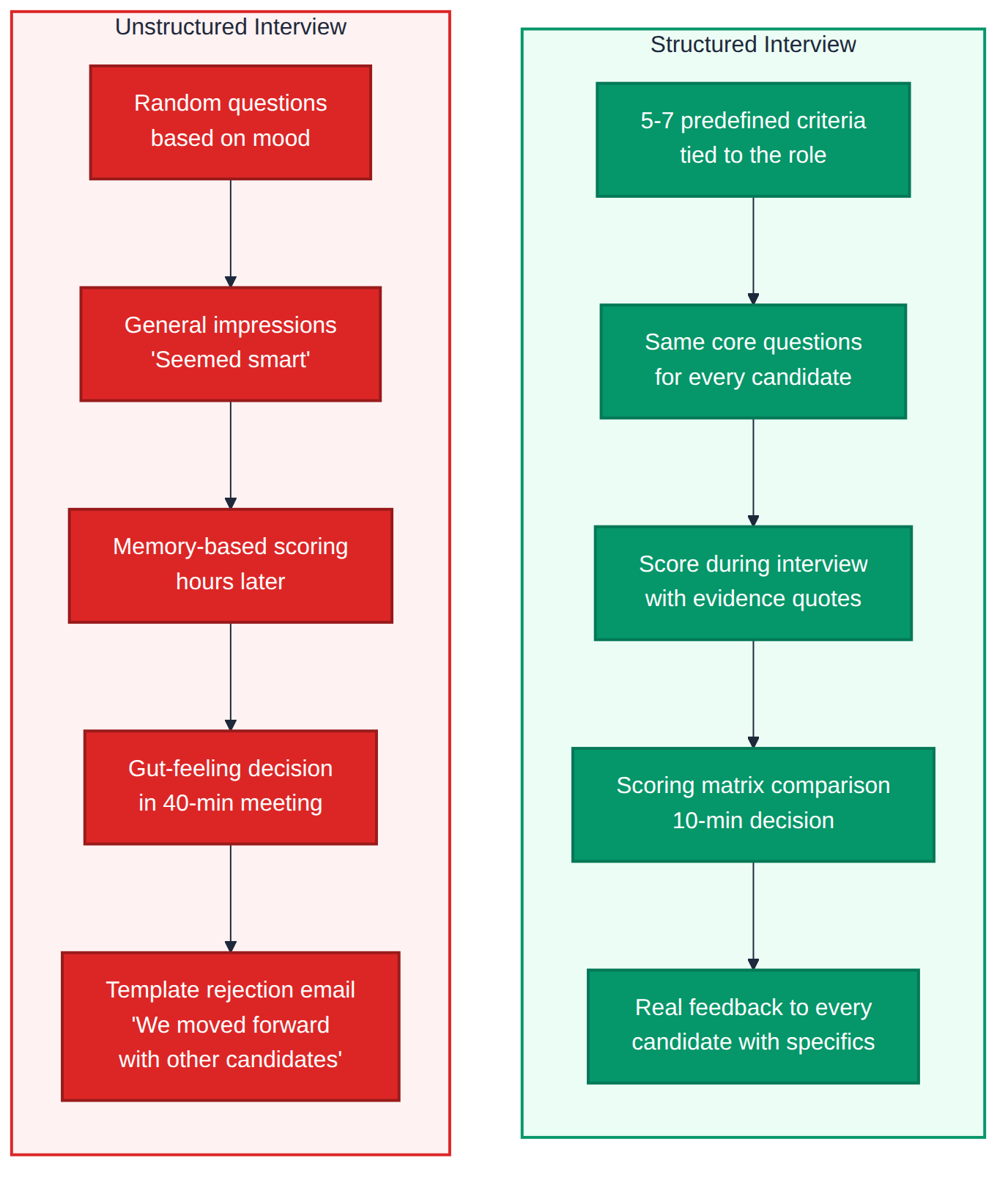
A hiring manager walks into a conference room. They have a resume, a laptop, and 60 minutes. No scoring rubric. No predefined questions. No criteria tied to the actual job.
They ask whatever comes to mind. The candidate talks. The hiring manager forms an impression. Afterward, they write something like "strong communicator, good culture fit, seemed smart" in a Slack message to the recruiter.
This is how most technical interviews work. And research consistently shows that unstructured interviews are barely better than a coin flip at predicting job performance.
The problem is not that interviewers are bad at their jobs. The problem is that they are running a conversation when they should be running a measurement.
What "Structured" Actually Means
A structured technical interview has three components. Questions tied to specific, predefined criteria. A consistent scoring scale applied to every candidate. Evidence recorded during the interview, not reconstructed from memory afterward.
This is not new. Industrial-organizational psychologists have been publishing research on structured interviews since the 1980s. Schmidt and Hunter's 1998 meta-analysis found that structured interviews have nearly double the predictive validity of unstructured ones. Google's internal research confirmed this in their Project Oxygen and re:Work publications.
The reason most companies still run unstructured interviews is not ignorance. It is effort. Building a scoring rubric takes time. Scoring consistently takes discipline. Comparing candidates across a matrix takes even more time. Most hiring managers are not full-time recruiters. They interview twice a month between their actual job responsibilities.
Step 1: Define Criteria Before You See Any Candidates
This is where most teams fail. They start interviewing before they agree on what they are looking for.
For a senior backend engineer, your criteria might look like this:
- System design: Can the candidate design a distributed system with appropriate trade-offs?
- API design: Do they understand REST conventions, error handling, versioning?
- Database knowledge: Can they choose the right storage engine and indexing strategy?
- Problem decomposition: Do they break complex problems into smaller, testable parts?
- Communication: Can they explain technical decisions to a non-technical stakeholder?
Five to seven criteria is the sweet spot. Fewer than five and you are not capturing enough signal. More than seven and interviewers lose focus.
Each criterion should be specific enough that two interviewers would agree on what constitutes a strong answer. "Culture fit" fails this test. "Can explain technical trade-offs clearly" passes it.
Step 2: Write Questions That Map to Criteria
For each criterion, prepare one primary question and two follow-up questions. The primary question should be open-ended enough that candidates at different levels will give noticeably different answers.
For the "system design" criterion, a primary question might be: "Design a notification system that sends 10 million push notifications per day. Walk me through the architecture."
A junior candidate will describe a single server with a queue. A mid-level candidate will introduce message brokers and horizontal scaling. A senior candidate will discuss delivery guarantees, retry strategies, monitoring, and failure modes.
The follow-up questions probe deeper: "What happens when the push notification provider is down for 30 minutes?" and "How would you monitor whether notifications are actually reaching users?"
The key rule: ask the same primary questions to every candidate. Follow-ups can vary based on their answers, but the starting point must be consistent. This is what makes comparison possible.
Step 3: Score During the Interview, Not After
This is the hardest habit to build. Most interviewers take general notes and then assign scores after the candidate leaves. By that point, they are scoring their memory of the interview, not the interview itself.
A better approach: after each major question, take 30 seconds to jot down the score and one line of evidence. A 1-10 scale gives you enough resolution to differentiate between candidates.
Each criterion also gets a weight from 1 to 5, reflecting how important it is for the role. System design for a backend role might be a 5. Communication might be a 2.
The evidence line is critical. "Candidate proposed event-driven architecture with dead letter queues for failed notifications, correctly identified the CAP theorem trade-off for the notification store" tells you exactly why they scored a 9. "Good answer" tells you nothing.
If you are conducting the interview solo, this is nearly impossible to do well. You are simultaneously listening, asking follow-ups, managing time, and trying to take structured notes. Something will slip.
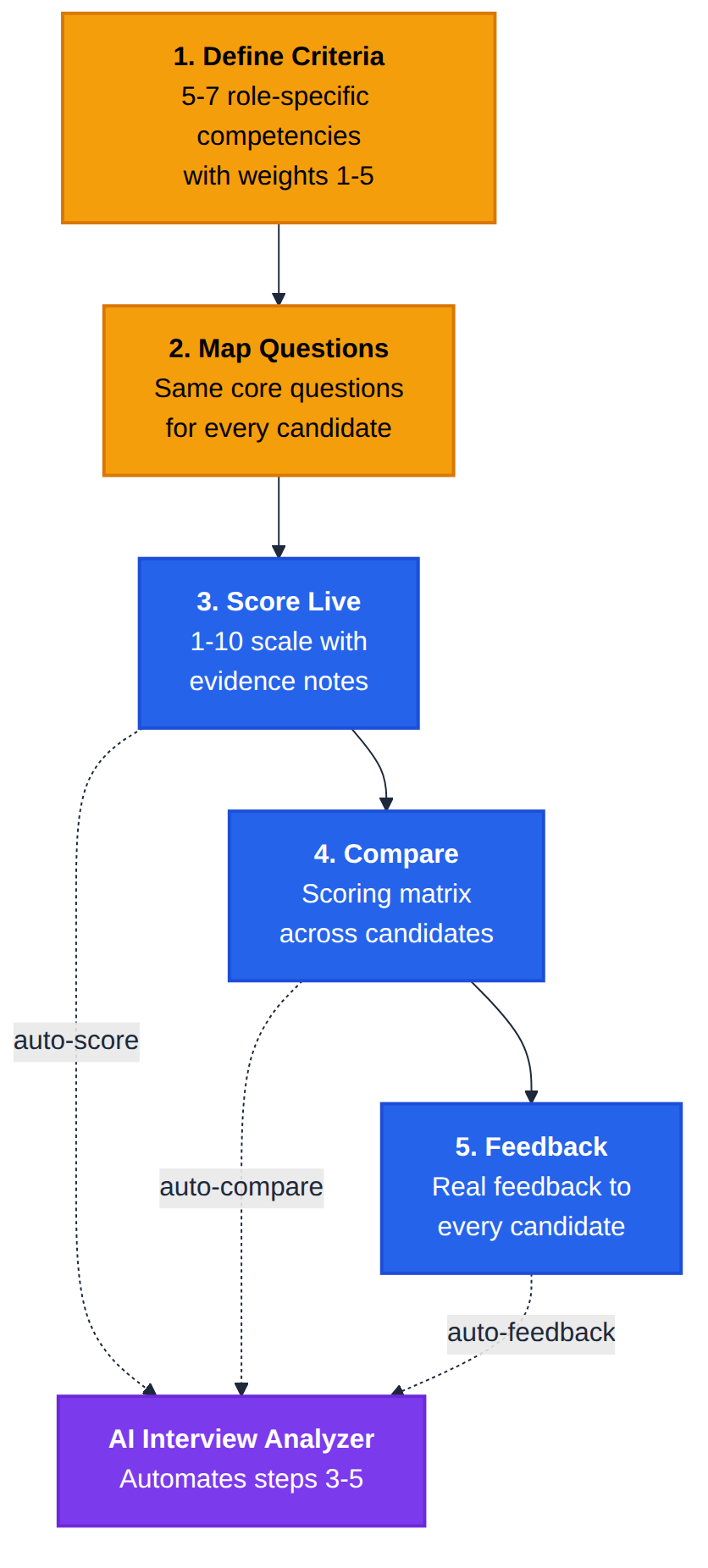
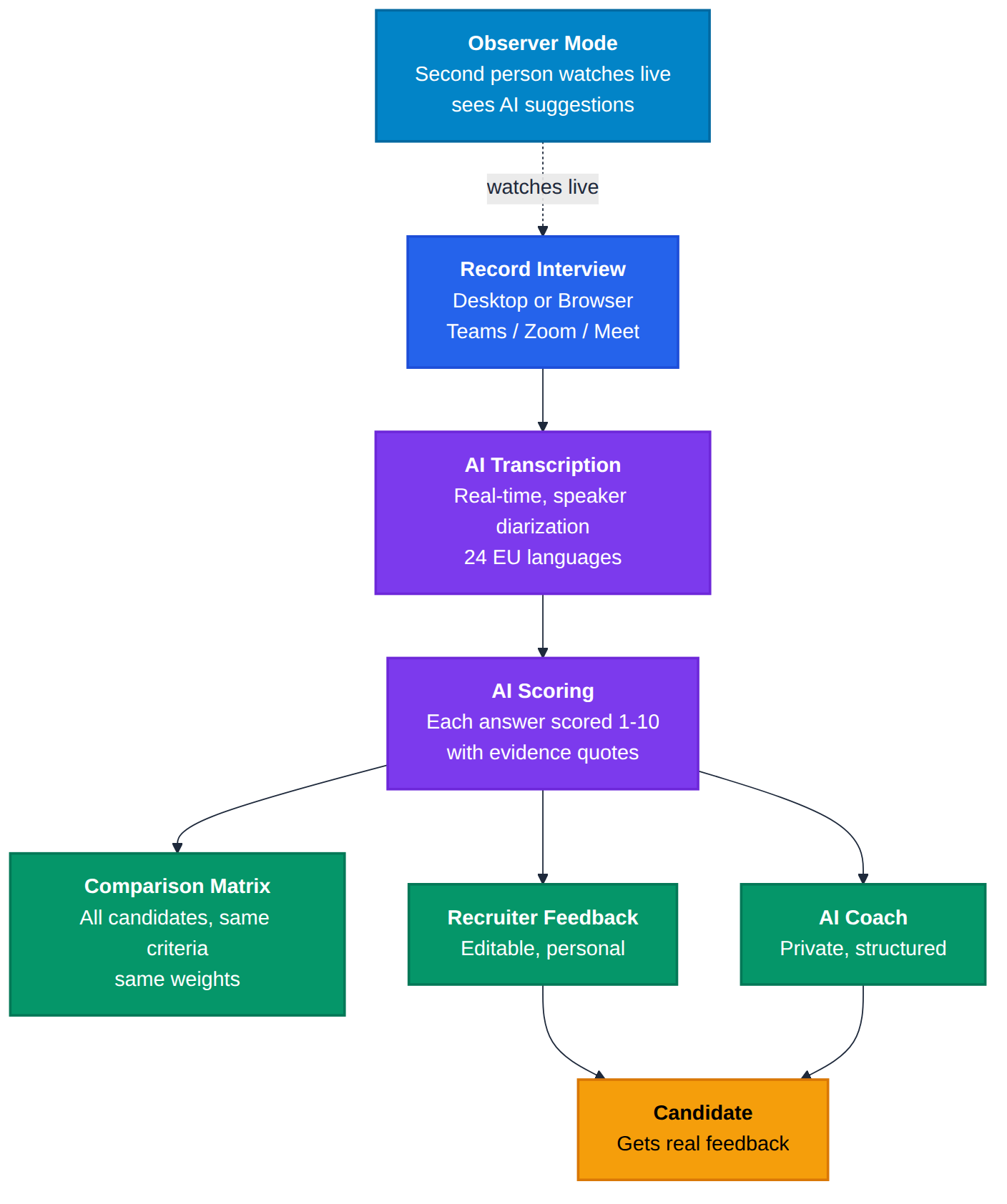
This is one of the reasons we built AI Interview Analyzer. The AI listens to the conversation, transcribes it, and after the interview scores each answer against your predefined criteria with evidence quotes from the transcript. The interviewer focuses on the conversation. The structured scoring happens automatically.
Step 4: Compare Candidates on the Same Axes
After all candidates have been interviewed, the hiring committee should compare them on the same criteria with the same weights.
Without a structured process, this meeting usually goes like this: "I liked Candidate A because they had great energy." "I thought Candidate B was more technical." "Candidate C reminded me of when I was starting out." These are not comparable data points.
With a scoring matrix, the meeting looks different.
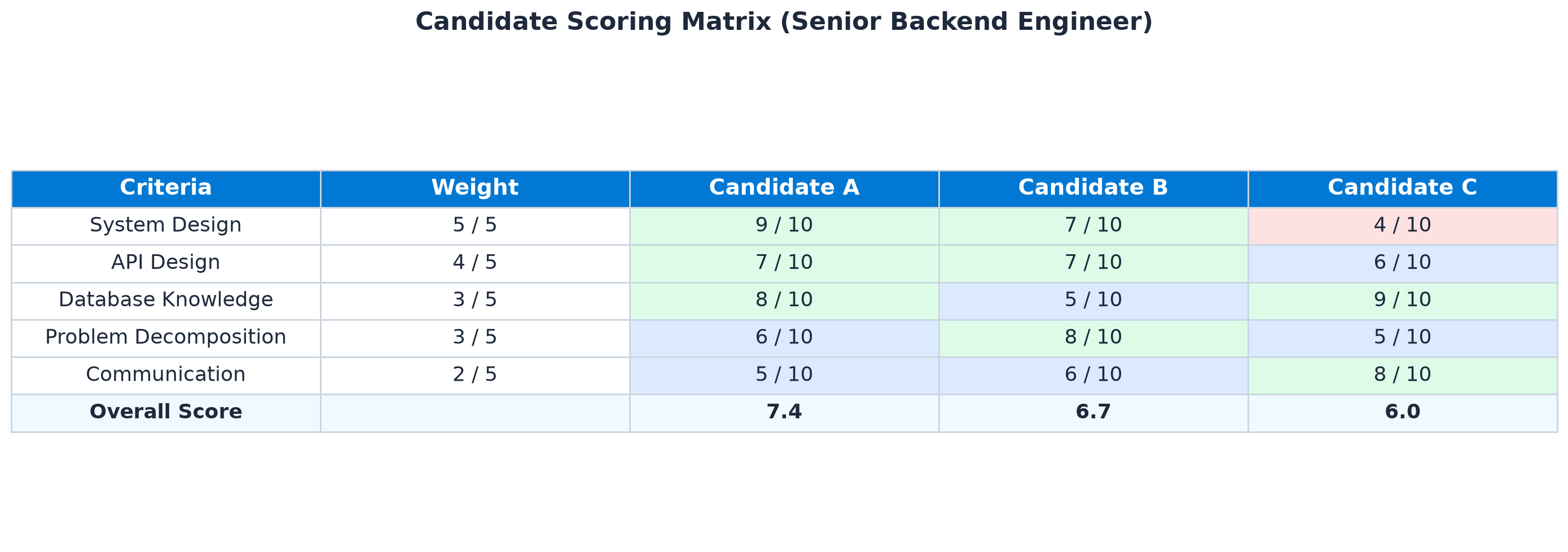
Candidate A scored 9/10 on system design (weight 5) and 5/10 on communication (weight 2). Candidate B scored 7/10 on both. Candidate C scored 4/10 on system design but 8/10 on communication.
Now the decision is about trade-offs, not impressions. System design carries weight 5 and communication weight 2, so Candidate A's overall 7.4 beats Candidate C's 6.0 for this backend-heavy role. But if the role were client-facing, you would adjust the weights and the answer might flip.
This comparison should take 10 minutes, not 40. The data is already there. The committee reviews it, discusses edge cases, and decides.
Step 5: Give Every Candidate Real Feedback
This is the step that almost nobody does. And it is the step that matters most for your employer brand.
A candidate just spent hours preparing for your interview. They took time off work. They were nervous. They performed. And then they get a template email: "We have decided to move forward with other candidates."
That is not feedback. That is a form letter.
Structured interviews make real feedback possible because you have criteria, scores, and evidence. You can tell a candidate: "Your system design answers were strong, particularly your approach to failure handling. We felt your API design answers showed some gaps around versioning strategy. We recommend looking into semantic versioning for REST APIs."
That takes two minutes to write when you have the data. It takes 20 minutes when you are trying to reconstruct it from memory. Most teams skip it entirely.
We built two candidate-feedback mechanisms into AI Interview Analyzer. One is recruiter-edited: the recruiter reviews the AI analysis, adjusts it, and sends a personalized message. The other is AI Coach: private candidate feedback and coaching generated by AI, sent only when both sides opt in, and invisible to the recruiter. It is derived entirely from what the candidate said in the interview. Every candidate gets something back.
The Observer Pattern: Training Junior Interviewers
One challenge with structured interviews is calibration. How do you ensure that Interviewer A and Interviewer B give the same score for the same quality of answer?
The traditional approach is calibration sessions: interviewers watch recorded interviews together and discuss their scores. This works but takes time that most teams do not have.
A faster approach is observation. A senior interviewer conducts the interview while a junior interviewer watches, takes their own notes, and scores independently. After the interview, they compare scores and discuss disagreements.
This is why we built observer mode into AI Interview Analyzer. A second person joins the session, sees the live transcription, receives AI-generated follow-up question suggestions, and can even take over recording if the primary interviewer needs to leave. The observer scores independently, and the team calibrates by comparing human scores with the AI-generated scores.
It turns every interview into a training opportunity.
Common Mistakes
Here are the patterns we see most often in teams trying to adopt structured interviews.
Criteria that are too vague. "Problem-solving ability" means something different to every interviewer. "Can decompose a monolith into microservices with clear bounded contexts" means the same thing to everyone.
Scoring after the interview. Memory degrades fast. Score during or immediately after each question, not at the end of the day.
Different questions for different candidates. If Candidate A gets asked about system design and Candidate B gets asked about algorithms, you cannot compare them. Keep the primary questions consistent.
Skipping the comparison step. Individual scores are useful. A scoring matrix across all candidates is where the real insight lives.
No feedback to candidates. If you have structured data, share it. Candidates who receive real feedback are more likely to reapply, refer others, and leave positive reviews.
Tools vs. Process
You do not need software to run structured interviews. A Google Doc with criteria, a 1-10 scale, and a comparison spreadsheet works.
But most teams that start with spreadsheets abandon the process within a month. The overhead is real. Writing up scores after every interview, copying them into a comparison sheet, formatting feedback emails. Each interview adds 30-40 minutes of administrative work.
We built AI Interview Analyzer to eliminate that administrative layer. You define your criteria. You press record and conduct the interview. The AI transcribes, scores with evidence, and generates the comparison matrix. You review, adjust, and send feedback.
The interviewer's job is to have a great conversation with the candidate. Everything else happens automatically.
Getting Started
If you want to try this with your next hire:
- Write down 5-7 criteria specific to the role before you interview anyone.
- Prepare one primary question per criterion. Ask the same questions to every candidate.
- Score each criterion on a 1-10 scale during the interview. Write one line of evidence per score.
- After all interviews, build a comparison matrix. Discuss trade-offs, not impressions.
- Send every candidate structured feedback based on the criteria.
If you want the AI to handle steps 3-5 automatically, try AI Interview Analyzer. 50 free credits, enough for a full interview. No credit card required.